
Beyond Butter Chicken: The Rhythm of Indian Meals
A guide to tasting, pacing, and savoring every bite, from Assam to your local Indian restaurant.

In Assam, meals follow a logic. Dishes are sequenced, not combined. Each arrives alone, does its work, and steps aside. Alkaline preparations are never mixed with fermented ones. Each course has a purpose: to prepare, nourish, or soothe. Richness is earned, not piled on. The meal moves deliberately, and when it ends, the body feels steadied rather than overwhelmed.
Every Bite a Story
Across Assam, where meals follow a sequence, and your local Indian restaurant, the lesson is the same. Indian meals—whether coastal, northeastern, or adapted for Midwestern palates—teach restraint and balance. American meals, especially Midwestern classics, tend toward comfort and indulgence but follow a similar intuitive logic. Variety in texture and taste keeps the diner satisfied. Noticing these patterns transforms a meal from a checklist of flavors into an experience that feels alive.
At your local Indian restaurant, the joy comes from letting each dish arrive in its own time, giving the palate room to rest, and savoring the meal as a thoughtfully orchestrated whole. Flavors step forward, linger, and recede like actors on a stage, each with its own part to play. No single element dominates. There is rhythm, dialogue, and sometimes a quiet surprise tucked between dishes. Even when recipes are adapted for local tastes, the meal still rewards patience and attention, like learning a language in which each ingredient has a voice.
The best meals, like the best stories, invite curiosity and presence. When you let them speak in turn, they reveal balance, intention, and the subtle pleasure of understanding a culture one bite at a time.
Assam: Discipline in Sequence
In Assam, dishes are eaten one at a time. Sour, alkaline, and fermented preparations are never combined. Each course has a job: to prepare, to nourish, or to soothe.
The meal begins with khaar and plain rice—alkaline, eaten alone. Nothing accompanies it.
Vegetables and dal come next, simply cooked, and brings the body back to neutral.
When that work is done, masor tenga (a light, sour fish curry) follows. It arrives only after khaar, never before or beside it.
The result is steadiness. Each flavor speaks once, clearly, and steps aside.
A Midwestern Parallel
The principle is similar in classic Midwestern meals: a crisp starter, a protein-driven main, a neutral starch, and a sweet finish. Comfort comes first, richness is balanced, and textures vary to keep the palate engaged. Noticing these patterns helps diners appreciate the logic behind Indian meals too.
Start: Caesar salad or onion rings — crisp and refreshing.
Main: Cheeseburger or fried chicken — protein-driven and savory.
Side: Fries or mashed potatoes — neutral, satisfying starch.
Acidic contrast: Pickles or slaw — cuts richness, used sparingly.
Finish: Apple pie or brownie — warm, nostalgic sweetness.
Butter Chicken: A Gentle Welcome
When most Americans think of Indian food, their mental menu often stops at butter chicken, naan, and samosa. That is not failure, merely habit, a culinary shorthand that helps diners feel safe in an unfamiliar restaurant.
Beloved, ubiquitous, and undeniably comforting, butter chicken draws diners in and leaves the rest of the culinary journey entirely up to them. Born in Delhi in the mid-twentieth century as a practical solution for leftover tandoori chicken, it reflects a particular moment and audience rather than centuries of domestic tradition. Along the way, it earned a special place at tables everywhere, behaving with the politeness of a diplomat, ready to introduce diners to a cuisine that elsewhere is fiercely regional, argumentative, and delightfully uncontainable.
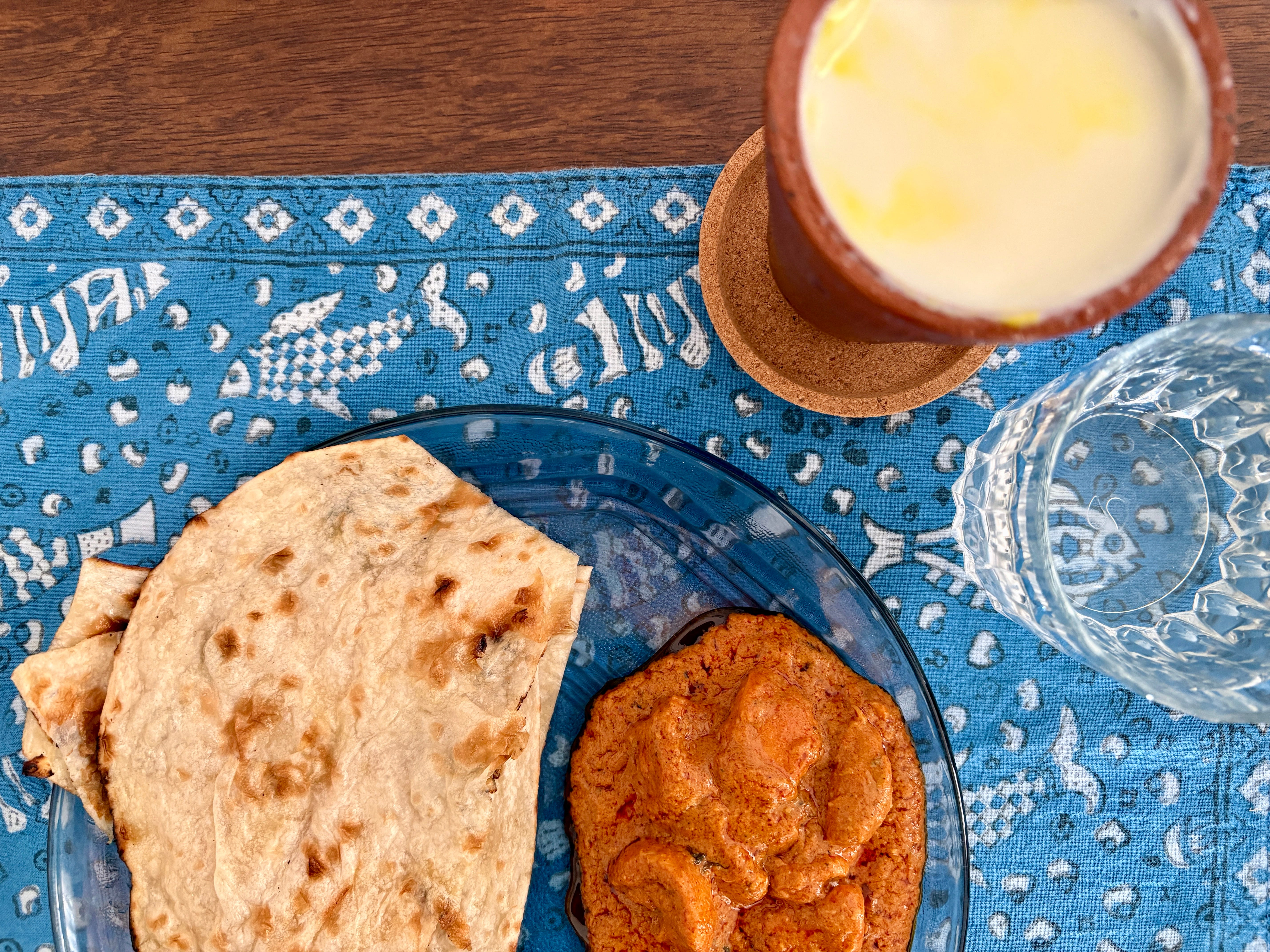
For diners approaching an Indian menu for the first time, butter chicken’s quiet genius lies in how gently it opens the door. Once confidence has been established, diners can begin to explore the richness and rhythm of a thali and the interplay of flavors that make each regional plate a small lesson in balance.
Indian Restaurants in the Midwest
The meals at an Indian restaurant in the Midwest provide a gentle introduction to Indian flavors, and paying a little attention can transform the experience.
A typical meal might include:
Appetizer: Vegetable samosa — crisp exterior with sweet-tangy chutneys
Gravy: Butter chicken or paneer makhani — rich and mildly spiced
Dry dish: Tandoori chicken or aloo gobi — smoky and spiced to counterbalance gravies
Carbohydrates: Naan and basmati rice — scooping and soothing the palate
Cooling element: Raita or plain yogurt — a neutral counterbalance
Thali and Buffet
Thali (a platter with an assortment of dishes) and buffet can feel overwhelming, but thinking in terms of pacing helps. Start with lighter items, move to richer gravies, balance with cooling accompaniments, and finish with dessert. Sampling a regional specialty alongside familiar favorites often reveals the kitchen’s strengths and the depth of the menu.
Start with an appetizer.
Move to lighter items: Dry vegetables, dal, and rice.
Follow with richer gravies: Sample heavier or spicier dishes in smaller portions.
Balance with cooling accompaniments: Yogurt or rice tempers heat and richness.
Finish with dessert or lassi: Enjoy the sweet last.
Ordering Indian Food for the Table
Each recommendation includes one appetizer, well-paired main dishes, and a starch choice (naan or rice, not both unless clearly appropriate). Appetizers may repeat. Soda pop is always a safe drink option, and lassi or mango lassi is suggested only where it naturally complements the meal.
If you’re spice-sensitive or new to Indian food, ask for mild spice when ordering. Indian food is about layered flavor, not just heat.
A. North Indian–Style Restaurant
Vegetarian Combos (for Two)
Creamy, mild, and comforting; naan works for both dishes.
Vegetable Pakora (appetizer)
Paneer Butter Masala + Dal Tadka + Naan
Mango Lassi or Soda Pop
Hearty and filling without bread.
Samosa (appetizer)
Chana Masala + Basmati Rice
Sweet Lassi or Soda Pop
Balanced flavors; both dishes are mild.
Vegetable Pakora (appetizer)
Saag Paneer + Vegetable Korma + Naan
Soda Pop
Non-Vegetarian Combos (for Two)
The most approachable and popular introduction to Indian food.
Chicken Pakora (appetizer)
Butter Chicken + Naan
Mango Lassi or Soda Pop
Protein plus lentils with bread.
Samosa (appetizer)
Chicken Tikka Masala + Dal Tadka + Naan
Mango Lassi or Soda Pop
A complete rice-based dish; no bread needed.
Vegetable Pakora (appetizer)
Chicken Biryani + Raita
Soda Pop or Sweet Lassi
B. Kerala-Style Restaurant
Kerala cuisine emphasizes coconut, curry leaves, and lighter breads. Naan and lassi are uncommon here, and meals are often centered around rice, appam, or dosa.
Vegetarian Combos (for Two)
Mild and comforting.
Banana Fritters or Vegetable Cutlet (appetizer)
Vegetable Ishtu + Appam
Soda Pop
Traditional and well-balanced.
Vegetable Cutlet (appetizer)
Avial + Thoran + Steamed Rice
Soda Pop
Traditionally a breakfast combo, but great any time of day.
Banana Fritters or Chips (appetizer)
Masala Dosa + Sambar & Chutney
Soda Pop
Non-Vegetarian Combos (for Two)
Tangy and coconut-based.
Fish Cutlet (appetizer)
Kerala Fish Curry + Steamed Rice
Soda Pop
A good first-time Kerala dish.
Chicken Cutlet (appetizer)
Chicken Ishtu + Appam
Soda Pop
A regional biryani.
Banana Fritters or Chips (appetizer)
Malabar Chicken Biryani + Raita
Soda Pop
C. What Not to Order Together
Biryani + Naan — Biryani is already a full rice dish; adding bread is unnecessary.
Two heavy, creamy curries (e.g., Butter Chicken + Korma) — Flavors blur together and the meal feels overly rich.
Multiple breads (naan + roti + appam) — One type of bread works best.
Lassi with Kerala dishes — Not traditional and often clashes with coconut-based flavors.
More than one rice dish (e.g., biryani + plain rice) — too much starch.
Munindra, after a life of strict itineraries, monuments and museums as a tour guide, learning over a cup of tea sounds delightful. Such good advice. India is vast and I will not be able to take it all in at once. I’ll study first, and read and savor each of your stories.
This article, so beautifully written and with such love, makes me want to travel to this part of India, a nation I’ve never visited. Balanced, explanatory and patient. Many thanks.